
Mathematics as Shelter and Method
The Curious Incident of the Dog in the Night-TimeMathematical thinking helps Christopher solve puzzles and regulate fear, while also demonstrating that intuitive certainty can be wrong.
increasing Bearing strength in each event
 decreasing
Bearing strength in each eventdecreasingNumbers as Structure

A Preferred Language
Rules That Can Be Followed
Christopher knows prime numbers and finds comfort in mathematical patterns. Problems may be difficult, but he expects them to have rules that can be tested.
Unlike social behavior, numbers do not change their meaning according to facial expression or tone.
A Form of Confidence
Mathematics gives Christopher a way to demonstrate competence. It is not simply an escape from life; it is a discipline through which he makes claims and checks them.
The Monty Hall Problem
Intuition Challenged
A Counterintuitive Puzzle
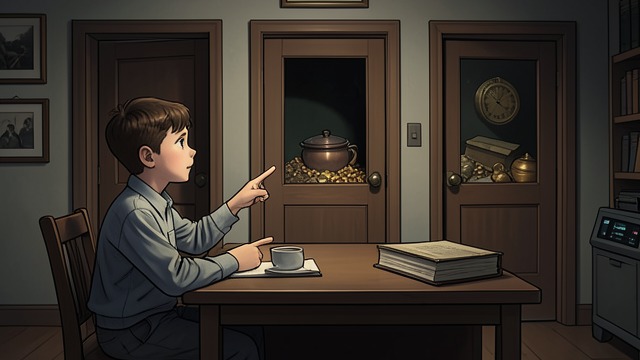
Christopher explains the Monty Hall problem: switching doors gives a better chance of winning because the host knows where the prize is.
Many readers and experts initially insist on an intuitive fifty-fifty answer.
Evidence Over Feeling
The example supports Christopher’s belief that logic can correct intuition. It also shows that a mathematically valid answer may remain surprising even after it is explained.
Calculation During Overload

Mathematics to Regain Focus
A Mental Task
Unable to organize the noise and movement at the station, Christopher works on Conway’s Soldiers. The problem fills his attention with rules and possible moves.
It helps him stay seated and begin thinking again.
A Temporary Tool
The calculation does not make the station quiet or remove the need to act. It creates enough mental order for Christopher to respond to Nigel’s questions.
Breathing Through the Exam

Numbers Under Pressure
A Difficult Start
Christopher opens the exam paper exhausted and struggles to breathe or solve the questions. He counts breaths and calculates cubes to steady himself.
The routine helps reduce panic enough for him to continue working.
Persistence Over Ease
He cannot check every answer, but he completes the examination. Mathematical preparation matters, yet emotional regulation is also necessary for him to use it.
Proof and Counterexample
A Formal Result
Building a Proof
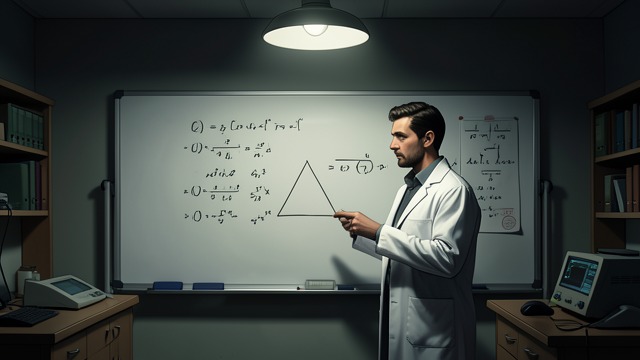
Christopher proves that sides of the form n² + 1, n² − 1, and 2n satisfy the condition for a right-angled triangle. Each algebraic step supports the conclusion.
The proof demonstrates the satisfaction of a problem with a clear answer.
Testing the Converse
He gives a right-angled triangle that does not fit the same pattern. The counterexample shows that one true statement cannot automatically be reversed.
At the beginning of Christopher’s account
After Christopher learns about Mother’s affair
At Swindon station before buying a ticket
During the first A-level paper
In the appendix after the story ends
